Maine Lobster vs Spiny Lobster: The Key Differences
Walk into a seafood restaurant in New England and order lobster. You will get a whole animal with two massive claws, a dark greenish-brown shell, and meat in the tail, claws, knuckles, and legs. Walk into a seafood restaurant in the Florida Keys and order the same thing. You will get a tail — just the tail — from a spiny, clawless creature with long antennae and a reddish-brown spotted shell. Both are called lobster. They are not the same animal.
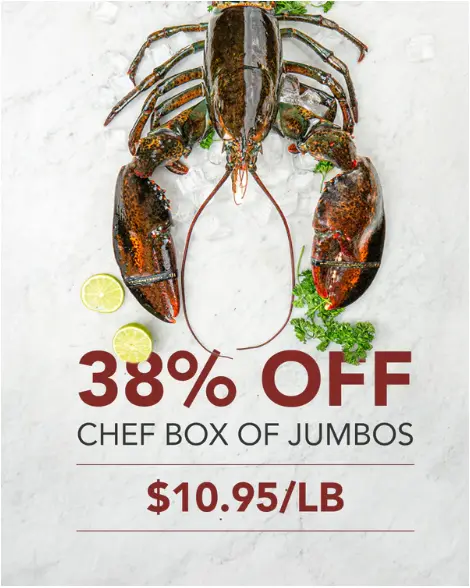
The Maine lobster — properly called the American lobster, Homarus americanus — and the spiny lobster — most commonly Panulirus argus in the Atlantic — are from different families, live in different environments, and produce meat with fundamentally different characteristics. Understanding the difference between them is essential for choosing the right one for your table.
This guide covers every dimension of the comparison: appearance, habitat, taste, texture, cooking methods, price, and sustainability. By the end, you will know exactly which one to buy and when. And if you decide the classic Maine lobster is what you want, you can order live lobster delivered to your door from the cold North Atlantic.
Appearance and Anatomy
The most obvious difference is the claws. Maine lobsters have two large, asymmetrical claws — a crusher claw on one side and a pincer claw on the other. The crusher is larger and denser, designed for breaking hard-shelled prey. The pincer is smaller and sharper, used for cutting and tearing soft tissue. These claws are loaded with meat that makes up roughly 30 percent of the lobster’s total edible yield.
Spiny lobsters have no claws. Instead, they have two long, thick antennae that can be longer than their body. These antennae are used for defense — spiny lobsters create a loud, rasping sound by rubbing the base of their antennae against their carapace, a noise that startles predators and gives the lobster time to escape. Their bodies are covered in forward-pointing spines — hence the name — which make them difficult for predators to swallow and painful for humans to handle without gloves.
Color is another distinguishing feature. Maine lobsters in the wild are typically dark greenish-brown, sometimes with a bluish or reddish tint. This camouflage helps them blend into the rocky seafloor of the North Atlantic. Spiny lobsters are lighter in color — typically brown with yellow spots or a reddish-brown mottled pattern — which provides better camouflage on coral reefs and sandy bottoms.
Rare color morphs exist in both species. Maine lobsters occasionally appear as bright blue, yellow, orange, or even calico (black and orange speckled), though these are anomalies caused by genetic mutations. The odds of finding a blue lobster are roughly one in two million. Spiny lobsters do not have the same range of color variation, though their base color changes depending on the specific habitat.
Habitat and Life Cycle
Maine lobsters are cold-water animals. They inhabit the rocky bottom of the North Atlantic from Labrador to North Carolina, with the highest concentrations in the Gulf of Maine, off the coast of Nova Scotia, and in the Bay of Fundy. They prefer water temperatures between 40 and 64 degrees Fahrenheit and are found at depths from the intertidal zone out to about 1,500 feet.
Spiny lobsters are warm-water animals. They inhabit tropical and subtropical waters around the world. The Caribbean spiny lobster ranges from Bermuda through the Bahamas, Florida, the Gulf of Mexico, and down to Brazil. Other species of spiny lobster are found off the coasts of Australia, New Zealand, South Africa, and throughout the Indo-Pacific. They prefer water temperatures above 68 degrees and are typically found in and around coral reefs, seagrass beds, and rocky ledges at depths from 3 to 300 feet.
The life cycle differences are equally stark. Maine lobsters are solitary and territorial. They live in rocky crevices and defend their chosen shelter aggressively. Spiny lobsters are social animals that aggregate in large groups. Caribbean spiny lobsters form migratory queues — single-file lines of dozens or even hundreds of individuals — that march across the seafloor to deeper water during storms or seasonal changes. This behavior has no equivalent in Maine lobsters, which are aggressively antisocial and will attack any lobster that enters their space.
Maine lobsters have a longer lifespan and grow more slowly. A legal-size Maine lobster is five to seven years old. A legal-size spiny lobster reaches harvest size in three to four years. Maine lobsters can live fifty years or more. Spiny lobsters typically live fifteen to twenty. These biological differences affect everything from the flavor of the meat to the sustainability of the fishery.
Taste and Texture Comparison
Maine lobster meat is sweeter than spiny lobster meat. The difference is not subtle — it is detectable in a blind tasting by anyone who eats lobster with any regularity. The sweetness comes from free amino acids that accumulate during the animal’s slow growth in cold water. Spiny lobsters grow in warmer water and faster, so they do not develop the same concentration of these compounds.
The texture is also different. Maine lobster tail meat is dense but tender, with a fine grain that separates into clean flakes. The claw meat is even more tender, with a delicate, almost buttery quality. The combined textural range — from the steak-like tail to the flaky claws — is what makes eating a whole Maine lobster such a varied experience.
Spiny lobster tail meat is firmer and more fibrous. The grain runs lengthwise rather than in flakes, and the meat holds together in dense, cohesive pieces. This makes it ideal for grilling and broiling, where the structural integrity of the meat prevents it from falling apart on the grate. But the same fibrous quality means spiny lobster does not have the same melt-in-your-mouth tenderness that Maine lobster claw meat provides.
Spiny lobster also has a more pronounced oceanic flavor — some would say it tastes more like the sea than Maine lobster does. The brininess is stronger, and the sweetness is weaker. If you prefer seafood that tastes overtly of the ocean, spiny lobster may be more to your liking. If you prefer subtle, sweet seafood, Maine lobster is the better choice.
For a more detailed description of what each type tastes like, our guide to what lobster tastes like covers the full flavor profile of both species.
Cooking Methods: Which One for What Dish?
The differences in texture mean that each species excels in different cooking applications.
Maine lobster is best steamed or boiled whole. Steaming preserves the natural sweetness and keeps the meat moist. The variety of meat from a whole Maine lobster — tail, claws, knuckles, legs — makes it the ideal choice for classic preparations like steamed lobster with drawn butter, lobster rolls, and lobster bakes. The claws in particular are the selling point: no other lobster species provides the combination of sweet, tender claw meat that the Maine lobster does.
Spiny lobster is best grilled or broiled as tails. The firm, fibrous texture holds up to high, direct heat without falling apart. Spiny lobster tails split in half and grilled with butter, garlic, and herbs are a classic preparation for a reason. The tails also work well for baking, stuffing, and any dish where the lobster is the centerpiece and needs to stand up to aggressive seasoning.
Spiny lobster is not well-suited to steaming whole because there are no claws to eat. You would be paying for the entire animal but only getting meat from the tail and a small amount from the body. For the same reason, spiny lobster is almost never used for lobster rolls — the texture is too firm and the flavor lacks the sweetness that makes a good lobster roll great.
Maine lobster can be grilled, but it requires more care. The claws and body need to be par-cooked first, or the exterior will dry out before the interior reaches temperature. Many chefs par-boil Maine lobsters for three to four minutes, then split them and finish them on the grill. This two-step process delivers both the sweetness of steamed lobster and the char of grilled meat.
For detailed instructions on whole lobster preparation, our guide to cooking lobster at home covers timing and technique for both species.
Price, Availability, and Sustainability
Maine lobster is generally less expensive than spiny lobster in North American markets. Live Maine lobster typically sells for $8 to $14 per pound depending on season and size. Spiny lobster tails — sold frozen — typically run $15 to $25 per pound, with Australian and New Zealand rock lobster tails commanding $25 to $40 per pound.
The price difference reflects different economics. Maine lobster is harvested in high volume from a well-established fishery with short supply chains to major North American markets. Spiny lobster is harvested in lower volume from a broader geographic range, and most of the product is processed and frozen before shipping, adding processing and logistics costs.
Availability is also different. Maine lobster is available year-round in live form across most of the United States. Spiny lobster is most commonly available as frozen tails, with availability peaking during the open season (typically August through March in Florida and the Bahamas) and declining during the closed season.
On sustainability, Maine lobster from the Gulf of Maine and Atlantic Canada is well-managed with strong conservation measures, as covered in our sustainable lobster guide. The stock is healthy, and the fishery operates under strict regulations. Spiny lobster sustainability varies by region — Bahamian and Florida fisheries are well-managed, while some Caribbean nations have weaker enforcement.
Which One Should You Choose?
The decision between Maine lobster and spiny lobster comes down to what you are cooking and what you value in the eating experience.
Choose Maine lobster when you want the classic whole-lobster experience — cracking claws, picking knuckles, and enjoying the range of textures from tail to claw. Choose it for lobster rolls, for steamed or boiled dinners, and for any preparation where the natural sweetness of the meat is the focus. Maine lobster is the more versatile option and the one that most people mean when they say they want lobster.
Choose spiny lobster when you are grilling or broiling and want a tail that holds its shape over high heat. Choose it for Caribbean-style preparations with bold spices and citrus. Choose it when you want the convenience of frozen tails that cook quickly and require no cracking or picking beyond splitting the tail shell. And choose it when the lower per-pound cost of frozen tails — compared to buying whole live lobster with claws — makes more sense for your budget.
Neither is objectively better. They are different products for different purposes. Understanding the difference means you can make the right choice every time. And when that choice is Maine lobster, you can buy fresh Maine lobster online and have it delivered live to your home.
Leave a Reply